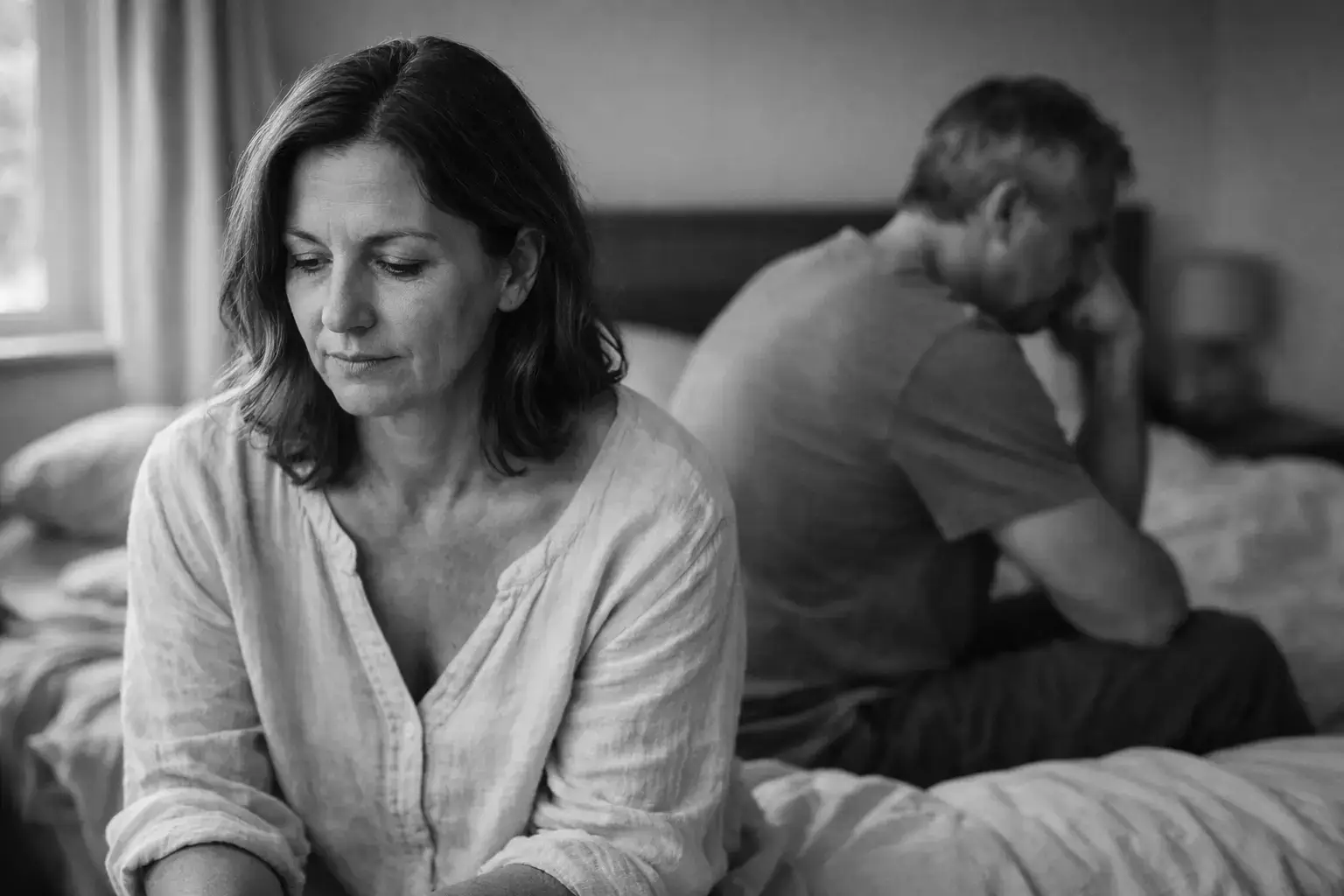
There can be a particular ache in lying beside the person you love and feeling your body pull away. You may wonder what causes desire shutdown when you once wanted sex, or when you still long for closeness but can’t find a path into it. You are not cold, broken, selfish, or failing your relationship. Your body may be responding to pressures, hurts and changes that deserve attention.
Desire is not a switch that stays on because we are in love. For many women, especially through perimenopause and beyond, it is a living conversation between the body, emotions, relationship and sense of self. When one part feels unsafe, depleted, unseen or under pressure, desire often steps back.
That does not mean it has gone forever. It means there is wisdom here. And listening to it can become the beginning of a more honest, heart-melting intimacy.
What causes desire shutdown?
Desire shutdown is rarely caused by one thing. It is often the result of several experiences layering on top of each other: a tired nervous system, hormonal shifts, years of carrying everyone else’s needs, resentment that has never had words, painful sex, body shame, or a relationship pattern where sex has started to feel like a test.
Your mind may say, “I should want this.” Your body may say, “Not like this. Not now.” The gap between those voices can create guilt, avoidance and tension between partners.
Female sexual desire is also responsive. It may not arrive before touch or appear out of nowhere on a busy Tuesday night. It can grow after you feel emotionally met, rested, desired without demand and connected to your own sensuality. If sex has become rushed, goal-focused or centred on someone else’s release, your body has very good reason to hesitate.
Perimenopause, menopause and physical change
Sexuality after menopause can be rich, expansive and deeply pleasurable. Yet the transition can bring real physical changes that deserve proper support. Lower oestrogen can contribute to vaginal dryness, discomfort, recurrent urinary symptoms and changes in arousal. Sleep disruption, hot flushes and fatigue can leave little capacity for erotic energy.
Painful sex is not something to push through. When intercourse hurts, the body learns to brace. Over time, even the suggestion of intimacy can trigger dread or shutdown. A GP, menopause-informed clinician, pelvic health physiotherapist or sex therapist can help you understand the options, which may include lubricants, moisturisers, hormonal treatment or support for pelvic tension.
Medication and health conditions can play a role too. Antidepressants, blood pressure medication, chronic pain, thyroid conditions, diabetes and depression can affect libido and arousal. This is not about blaming your body. It is about bringing the whole picture into view so you can make informed choices with qualified health professionals.
When stress becomes a desire problem
Many women have spent decades being capable. You manage work, family, ageing parents, the household, emotional labour and the invisible details that keep life moving. By the end of the day, your body may crave solitude, sleep or a cup of tea without anyone needing anything from you.
Desire usually struggles under relentless pressure. A nervous system in survival mode is scanning for what must be done next, not opening to pleasure. This is why telling yourself to relax rarely works. Your body needs repeated experiences of enoughness, rest and choice.
There is also a trade-off worth naming. Scheduling time for connection can protect intimacy in a full life, but if every planned encounter becomes an expectation of sex, it can create more pressure. Try protecting time for affection, conversation, massage, laughter or lying together with no promised outcome. Pleasure grows more easily when there is room to choose.
Relationship hurts and sexual desire discrepancy
Sexual desire discrepancy is common in long-term relationships. One partner wants sex more often, more quickly or in different ways. The problem is not automatically the difference itself. The pain comes from what the difference begins to mean.
The higher-desire partner may feel rejected, unwanted or lonely. The lower-desire partner may feel pursued, inadequate or responsible for keeping the peace. Then a painful cycle takes hold: one reaches harder for reassurance through sex, the other retreats to escape pressure. Both people can feel deeply alone.
Sometimes the question beneath “I’m not attracted to my partner anymore” is more complex. Has there been criticism, betrayal, unresolved conflict, unequal labour, emotional distance or years of not feeling cherished? Attraction can shrink when resentment has nowhere to go. It can also shift when a woman has spent so long abandoning herself that she no longer knows what she wants.
This is where couples therapy can be transformative. Emotionally Focused Therapy helps partners move beyond blame and identify the tender emotions driving the pattern. Rather than arguing about how often sex happens, you begin asking: Can I reach for you without pressure? Can you tell me the truth without fearing I will fall apart? Can we create connection that feels safe for both of us?
Body image, shame and the fear of being seen
A body does not become less worthy of pleasure because it has changed. Yet many women have absorbed the message that desirability belongs to youth, thinness and perfection. Menopause, weight changes, scars, illness, childbirth and ageing can make being naked feel exposed rather than liberating.
If you are monitoring your stomach, breasts, thighs or face during intimacy, you are not fully inside your experience. You are watching yourself from the outside. That vigilance steals attention from sensation.
Sexual confidence is not performing confidence for somebody else. It is the growing ability to inhabit your body, name your boundaries and receive pleasure without apologising. This can begin in ordinary moments: wearing something that feels beautiful against your skin, moving to music, taking time to notice what brings comfort, or allowing yourself to be looked at by your partner without immediately deflecting.
For some women, shame is tied to earlier messages about sex. Perhaps pleasure was called selfish, dangerous or dirty. Perhaps consent was blurred, boundaries were ignored, or your body learned that intimacy came with a cost. Trauma-informed support honours the pace of your nervous system. You never have to force your way towards desire.
How to begin reconnecting with desire
Start by removing the demand that you must want sex in a particular way. Desire may first return as a wish for warmth, touch, romance, playfulness, privacy or feeling beautiful. Let that count.
Have one honest conversation with your partner outside the bedroom. You might say, “I miss feeling close to you, and pressure makes it harder for my body to open. I want us to learn a different way together.” This is not rejection. It is an invitation to build something more sustainable.
Then become curious about your own conditions for desire. Consider when you last felt alive in your body. Was it after a walk near the sea, when you had time alone, when your partner was attentive, or when you felt emotionally held? Your answers are not frivolous. They are clues.
If you want to know how to want sex again after 40, begin with self-connection before sexual performance. Slow down. Explore touch that is not designed to lead anywhere. Let pleasure be wider than intercourse. A kiss, a shared bath, sensual massage, deep eye contact or a loving conversation can restore the bridge between your heart and sex centres.
And if you are wondering, “Should I stay or should I leave?”, do not make a life-changing decision based only on the absence of desire. Look at the whole relationship. Is there respect? Accountability? Emotional safety? A willingness from both of you to face the pattern? Desire can return in a relationship that is willing to change. It cannot thrive where there is coercion, contempt or ongoing harm.
You deserve intimacy that delights your soul, not sex you endure to avoid disappointing someone. Your beauty, power and magic have not expired. They may be waiting for more truth, more safety and more space to come home.
For personalised support with low desire, menopause changes, body image or relationship disconnection, email tarisha@sexualempowermentforwomen.com for more support.