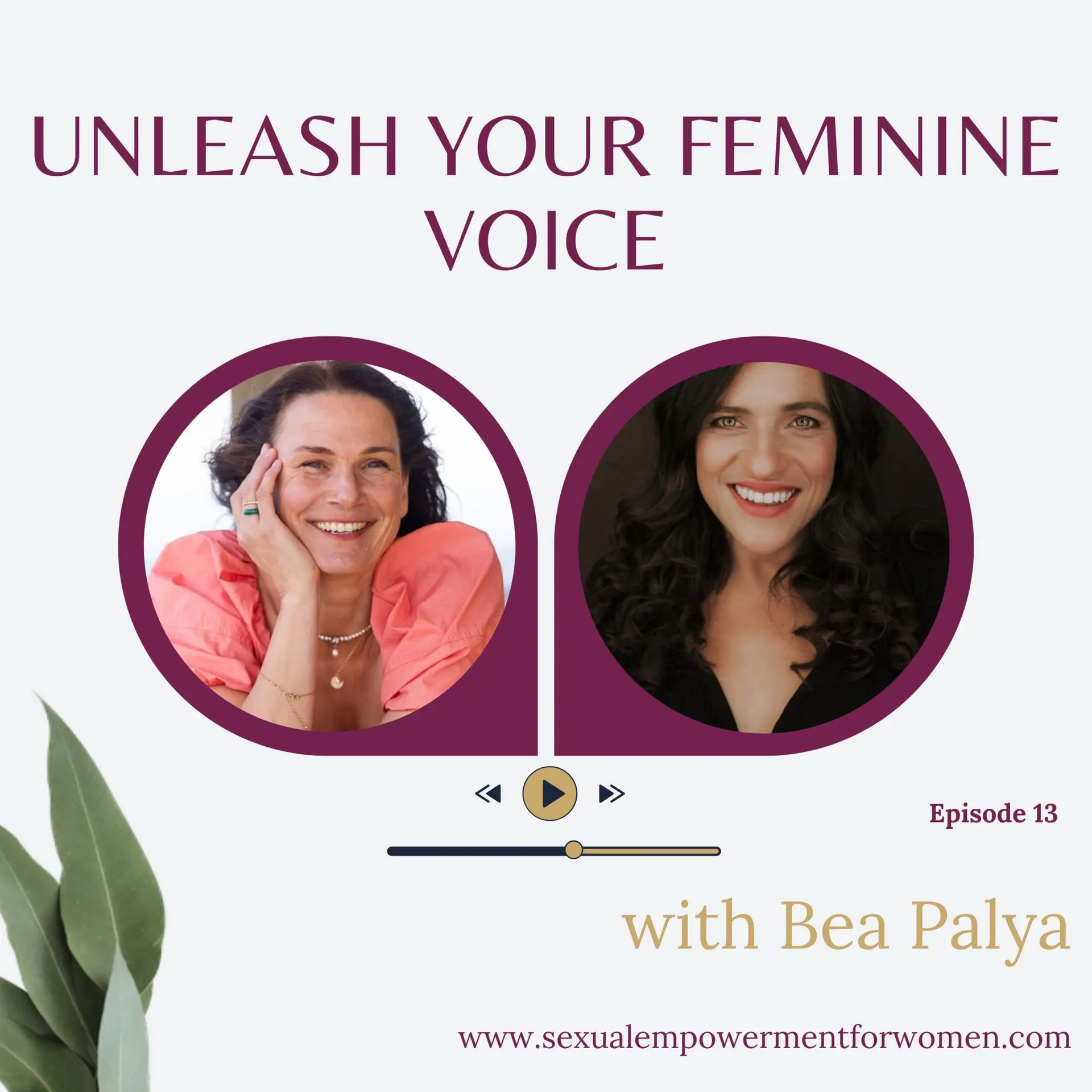
Your voice and your sexuality live in the same place in your body. When one is squeezed shut, the other goes with it. In this episode of the Sexual Empowerment for Women podcast, Hungarian singer, songwriter and voice coach Bea Palya shows how finding your authentic feminine voice changes the way you speak, the way you’re heard, and the way you feel pleasure in your own body.
Why Your Voice and Your Sexuality Are Connected
Think about the last time you really wanted to say something and didn’t. Where did you feel it? Most women point to the same places, the throat, the chest, the belly. That tightening isn’t only emotional, it’s physical, and it doesn’t stay in your throat. It travels down.
Bea has spent three decades on stage, including singing at Carnegie Hall, and she’s worked with hundreds of women on their voices. What she sees again and again is that a woman who can’t let sound out freely usually can’t let pleasure in freely either. The same guarding runs through both. If you’ve ever noticed that you go silent in the bedroom, or that you hold your breath, this is the thread you’re looking for. You can read more about that connection in how to reconnect with your body sexually.
What Happens When You Don’t Use Your Full Voice
Women are trained early to take up less sonic space. Don’t be loud, don’t be too much, soften it, smile while you say it. Decades of that leaves a mark, and it shows up in ways that seem unrelated:
- You get talked over in meetings and can’t work out why
- You go silent during intimacy, even when something feels good
- You can’t ask for what you want, in bed or anywhere else (this piece on how to talk about desire goes deeper)
- Your breathing stays shallow, which keeps your nervous system braced
- You feel disconnected from your own body without a clear reason
None of that means anything is wrong with you. It means your voice has been managing risk on your behalf for a very long time.
Singing as an Embodiment Practice
Here’s what surprised me most in this conversation. Bea doesn’t teach singing so women can sound beautiful. She teaches it because sound is a way back into the body, and it works faster than talking about feelings does.
When you make sound with your whole body, your ribs move, your belly moves, your pelvic floor moves. You can’t sing from your full range and stay clenched at the same time, it’s physically impossible. So the practice does the unwinding for you. Bea even talks about singing from your vagina, and about writing what she calls Vagina-songs, which is exactly as bold and as funny as it sounds. If you want more practices in this direction, have a look at feminine embodiment practices for confidence.
What You’ll Hear in This Episode
- Why singing and sexuality run along the same channel in the body
- How vocal work helps women say what they actually mean
- What Bea means when she says sound is always connection, to yourself and to other people
- Why vocal exercises reach places that talk therapy sometimes can’t
- What it means to speak and sing from your vagina, and why Bea wrote Vagina-songs
- How professional women use voice work to command attention without hardening
This was one of the most delightful conversations I’ve had on the show. If you only listen to one episode, make it this one.
About Bea Palya
Bea Palya is a well-known Hungarian singer, songwriter, coach and teacher. After three decades on stage, with highlights including Carnegie Hall, she now helps professional women connect their body to their voice so that when they speak with their full voice, people actually listen.
Find her at palyabea.hu, or write to info@palyabea.hu for upcoming course dates. You can also book a discovery call.
Follow Bea on Instagram, Facebook and LinkedIn. Listen to her music: Igen and Hazatalalok en.
Frequently Asked Questions
What is an authentic feminine voice?
It’s the voice that comes out when you’re not managing how you sound. It’s connected to your breath and your whole body rather than sitting thin and tight in your throat, and it carries your actual feeling instead of a polished version of it.
Do I need to be able to sing to do voice work?
No. This isn’t about talent or being in tune. It’s about letting sound move through your body without holding it back, and anyone with a voice can do that.
How does voice work help with intimacy?
Sound and breath open the same places that pleasure travels through. Women who start making sound freely often find they can ask for what they want more easily, stay present during sex instead of drifting off, and feel more sensation in their bodies. There’s more on unwinding the holding in healing shame around sexual pleasure after 40.
Is this useful if my issue is being talked over at work?
Yes, and Bea works with a lot of professional women on exactly that. A voice that’s connected to the body carries differently in a room, and people respond to it without you having to push or harden.
Listen to the Full Episode
Apple Podcasts | Spotify | Amazon Music | YouTube
Ready to Take Up More Space?
If something in this conversation made you want to open your mouth wider, start with Sexual Empowerment for Women That Lasts, or explore the full library of courses and workshops at sexualempowermentforwomen.com.
With a big warm hug,
Tarisha