If your desire has gone missing in your 40s or 50s, it’s tempting to blame your hormones and leave it there. But the loss of libido in perimenopause is rarely only about hormones, and that’s good news, because it means there’s so much more you can do than wait it out.
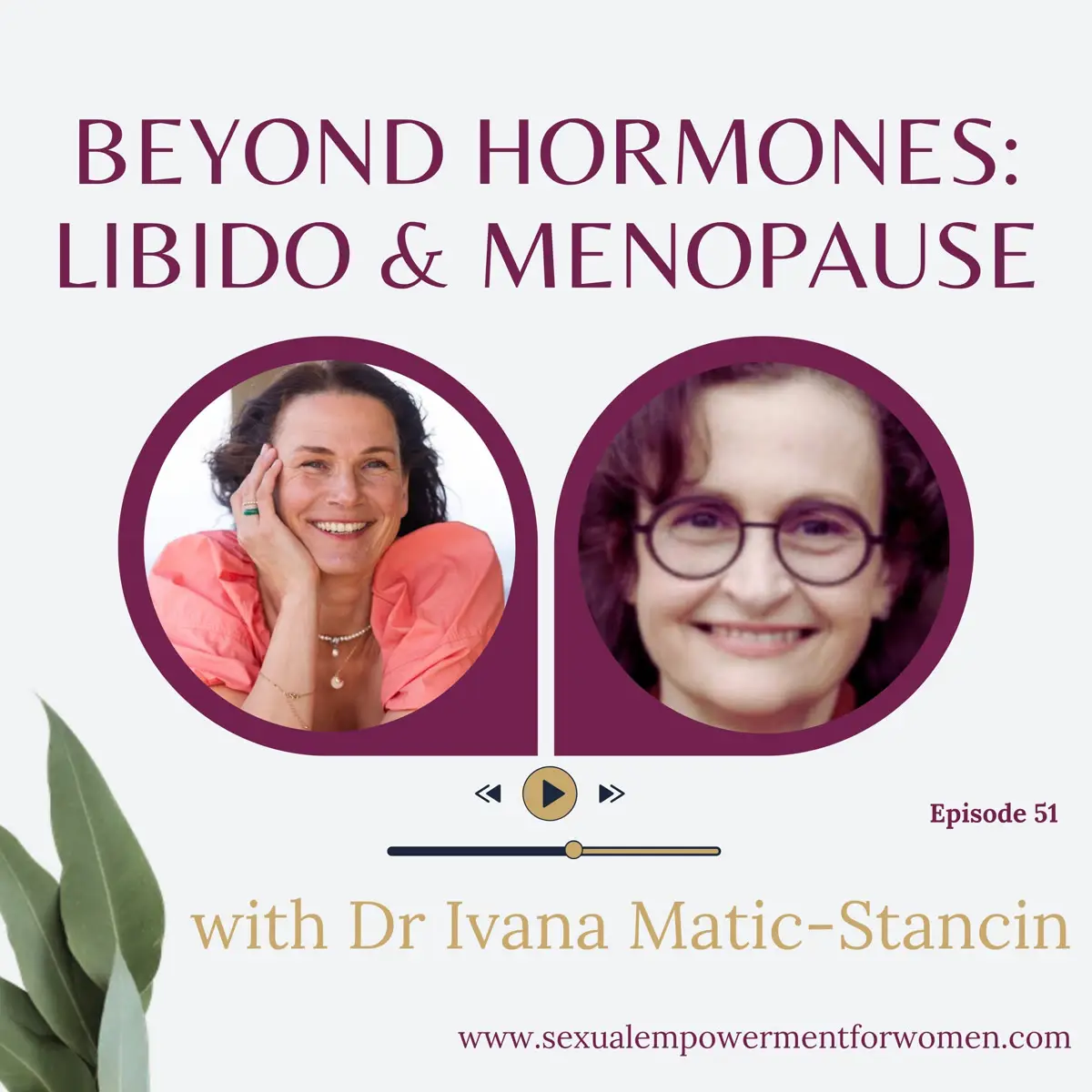
In this episode of the Sexual Empowerment for Women podcast I talk with Dr Ivana Matic-Stancin, a Melbourne GP who sees perimenopausal women every week. You’ll hear why almost every woman in her clinic says her libido has disappeared, how burnout, loneliness and an exhausted relationship feed into it, and why slowing down and coming back into your body might be the most important health decision you make at this stage of life.
Prefer to listen? The audio version is right here.
Listen and Subscribe
Press play above, or listen wherever you keep your podcasts. Subscribing is the thing that helps other women find this work.
“Please Don’t Ask Me That Question”
Ivana sees women with every kind of story, different genes, different lifestyles, different histories. Yet one thing shows up almost uniformly in her menopause clinic, and it’s loss of libido.
When she asks how their libido is, she says nearly every woman tells her it just doesn’t exist. Many add, please don’t ask me that question.
What struck me is that most women would never bring it up themselves. Tiredness, poor sleep, body aches, hot flushes, vaginal dryness, gut changes, palpitations and anxiety all feel more urgent. So sex sinks to the bottom of the list, and it gets treated as insignificant. Yet as Ivana put it, the thing we pay the least attention to is often where the key is.
Why Loss of Libido in Perimenopause Isn’t Only Hormonal
Medicine still tends to split us into pieces. Physical health over here, emotional health over there, and then the body divided into organs, with each specialist looking after their own part. Ivana calls that a false division, and she says it misses the whole story during big life transitions.
She described perimenopause as a mirror image of puberty. Your hormones, gut, heart, immune system and nervous system all talk to each other, so when hormones fluctuate, everything feels it. That’s part of why so many women notice brain fog and palpitations.
Even so, the medical conversation often shrinks down to one question: do you take hormone replacement or not? Ivana thinks it’s an important question, and she sees it really help some women. But it isn’t the answer for everyone by default, and in her words, the loss of libido in perimenopause can’t be boiled down only to a lack of hormones.
Burnout, No Village, and an Annoying Partner
Ivana sees so many women in their 40s and 50s living in burnout. They’re carrying children, ageing parents, careers, their own health, their partner’s health and the finances, and they’ve been soldiering since their 20s and 30s.
We also don’t have a village anymore. She mentioned that loneliness is now rated as a bigger health risk than smoking, and that really stopped me.
Here’s the part I loved. Without a village, your partner becomes the one person you expect to help carry everything, and of course he can’t. So you get irritated. He isn’t taking the bin out or doing the dishes, and the last thing on your mind is wanting his touch. If you recognise that drift, have a read of how to reconnect intimacy when you feel like roommates, not lovers.
Desire Needs Your Heart to Feel Safe
When I ask women about their connection with their partner, so many tell me they don’t feel emotionally safe. As we get older, sex becomes less about physicality and more about our heart connecting to our sexuality.
Many of us have more responsive desire, so it often isn’t that the desire is gone. It’s that you don’t want to respond to this partner right now, because your heart is closed. Ivana added that after 10, 20 or 30 years together, some couples haven’t grown together at all, they’ve just been cohabiting to get through the chores, the kids and the jobs.
That’s why I start with softening. When we’re functioning and soldiering, there’s no softness in us, and our partner can start to feel we’ve become a threat. When you soften first, the conversation has somewhere to go. There’s more on this in emotional safety vs sexual chemistry.
From McDonald’s to a French Chef
So many women have spent decades pleasing others and using their bodies for the family. They never learned what sex that actually nourishes them feels like. I say it’s like being fed McDonald’s your whole life, then deciding you don’t want McDonald’s anymore, and concluding you don’t want food at all. What they’d really love is a French chef cooking something so delicious they think, I want this.
Part of the shift is letting go of orgasm as the goal of sex. When orgasm is the goal, it becomes hard work for both of you. Instead, when connection and pleasure are the goal, even two minutes of connected touch can feel good, and women relax.
I also invite women to stop waiting until they’re perfectly happy and relaxed. What if you asked your partner to make love to your tiredness, your sadness or your anger? Ivana pointed out this takes conversations first, because our partners grew up with the same old messages we did. In my experience, though, it’s often women who judge our changing bodies far more harshly than men do.
Your Body Isn’t a Machine You Operate
Ivana talks about top down and bottom up healing. Talking therapy works from the head down. Somatic approaches, like massage, yoga or movement, work from the body up and bring you back into the present moment.
By our 40s and 50s, she says, many of us treat the body like a machine we operate. As we talked, she landed on something lovely: sex with a partner you feel safe with, and playful with at the same time, may be the best somatic therapy there is. And it’s free.
She also learned from Esther Perel that sexuality is our life force, our desire for life. When we cut ourselves off from sex, we often cut ourselves off from touch too, and we start to dry out. If you’d like a place to begin, try these feminine embodiment practices for confidence.
Slow Down and Choose the Next 40 Years
I asked Ivana for her one message to women listening. Her answer was to slow down, not stop, and not drop any of the balls you’re holding, because they’re precious to you. Just slow down enough to reconnect with yourself.
She sees this stage as a real choice point. If you move through perimenopause in a healthy way, you set yourself on a trajectory for another 40 years of healthy, vibrant life. She thinks of her patients in their 80s and 90s who are in safe and playful relationships, and the difference it makes to their health.
Frequently Asked Questions
Is loss of libido normal in perimenopause?
Yes, loss of libido in perimenopause is very common. Ivana sees it in almost every perimenopausal woman in her clinic, though most women don’t mention it unless she asks.
Will HRT bring my libido back?
For some women hormone replacement really helps, but it isn’t the answer for everyone. Stress, burnout, your relationship and your connection with your body all play a part too. Talk with your doctor about what suits you.
Why am I so irritated with my partner in perimenopause?
Without a village to lean on, your partner often becomes the one person you expect to carry everything with you. No one person can meet that, so frustration builds and desire for his touch drops.
Can I get my desire back after menopause?
Yes, it’s never too late. Slowing down, feeling emotionally safe, shifting away from orgasm as the goal and coming back into your body can all help it return.
For the CBT side of this conversation, listen to my episode on menopause and libido.
About Dr Ivana Matic-Stancin
Dr Ivana Matic-Stancin (MD, Dip Obs & Gyne, FRACGP, FASLM, HCANZA) is a Melbourne-based GP with over 25 years of clinical experience in women’s health and lifestyle medicine. She takes a whole-person approach to perimenopause and healthy ageing. Ivana offers one-on-one consultations, a 6-week Mastering Menopause program based on CBT, and online services. She practises at Maxwell Medical Group in Braybrook, Victoria, and speaks English, Serbian and Croatian. Find out more at doctorivana.com.au.
Ready to Feel Alive in Your Body Again?
Take the free 60 second quiz and discover your Sexual Desire Blueprint: sexualempowermentforwomen.com/quiz. Or start the free mini-course, Reclaim Your Sexual Confidence.