You lie next to him and feel nothing. Not anger, not hurt, just a flatness where desire used to live. You have wondered whether something in you is broken, whether this is what a sexless marriage looks like from the inside, and whether you will ever want sex again the way you once did. If any of that lands, this conversation is for you.
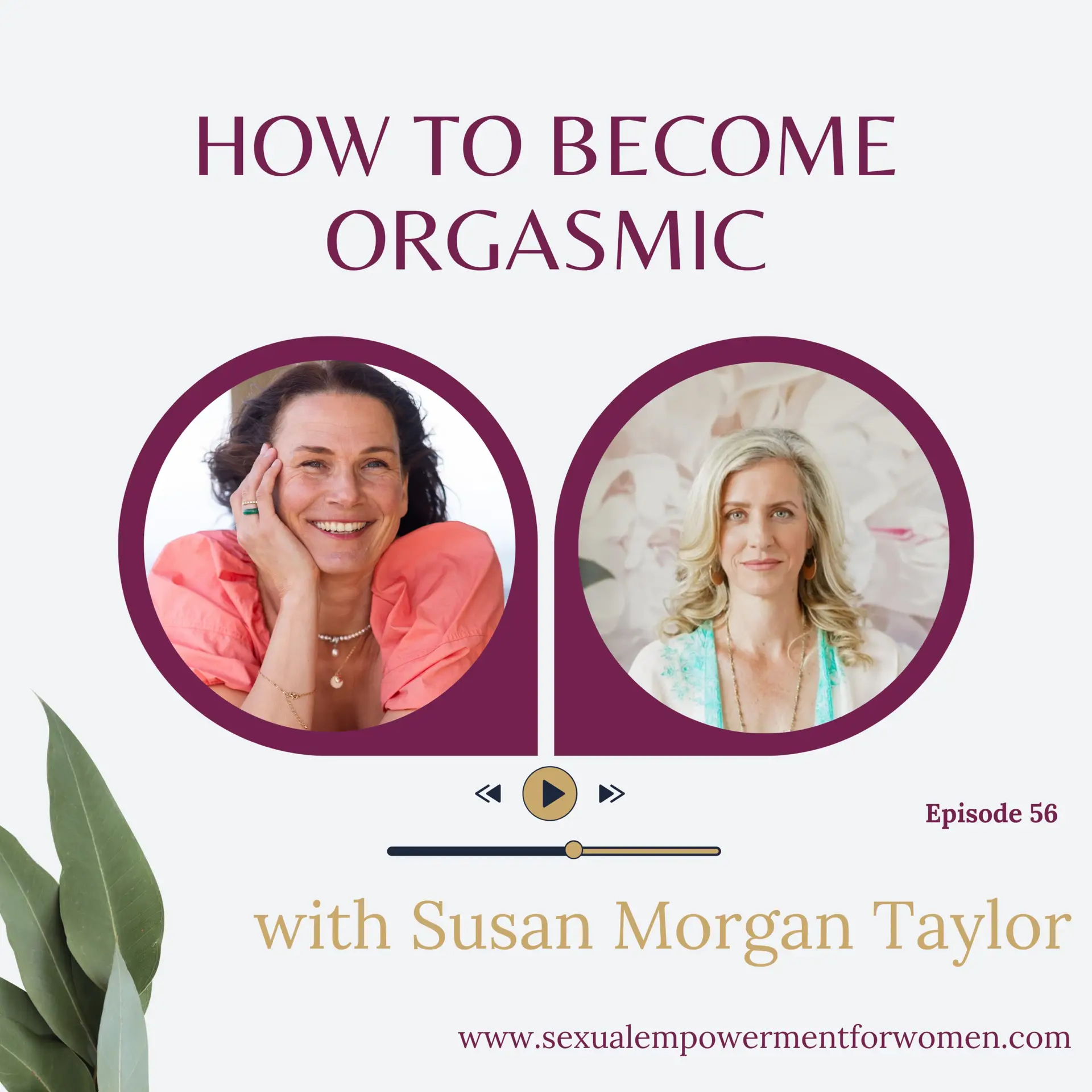
In episode 56 of the Sexual Empowerment for Women podcast I sit down with somatic sex therapist Susan Morgan Taylor, and she tells a story most women never hear said out loud. She spent years in a marriage with almost no sex, waiting for her husband to become the lover she longed for. Then she left, and discovered the truth she had been avoiding. She had been the shut down one all along.
Why Women Stop Wanting Sex in a Long-Term Relationship
Susan describes the years before her divorce as a slow numbing. She longed for a deeper, more intimate connection and had no idea how to get there, so she did what many of us do. She made it his fault. He does not know how to be my lover. He does not know how to move me.
Then the marriage ended, and something surprising happened. Her life force came surging back online. She felt alive again. She had a sex drive again. And a couple of years later she met a man who promised to rock her world, and the exact same flatness returned.
That is the part worth sitting with. The pattern followed her. Changing the man did not change the experience, because the block was never really about the man. If you have ever left one relationship hoping the next one would fix your desire, you already know this in your body. (This is the same ground we cover in how to reconnect after rejection with your partner.)
The Myth That Someone Else Can Give You an Orgasm
We have all absorbed the language. Here is how he can give her the best orgasm of her life. Susan heard the same promises, including from a partner who told her he would give her a full body orgasm.
What she found instead was this: nobody can give us pleasure. Pleasure, orgasm, even love are states that already exist inside our own bodies. They are the way the body responds. They are a pathway every one of us already has.
This reframe matters enormously, because it moves you out of something is broken in me and into something far more workable. Nothing needs fixing. The pathway is already there. What is needed is clearing what has piled up on top of it.
What Actually Blocks Pleasure and Desire
Susan uses an image I keep returning to. Think of a river flowing. Debris collects, and eventually you have a dam. That is what happens to our capacity for pleasure, connection and different kinds of orgasm.
The debris is emotional. It is the unwillingness to feel the things that are uncomfortable, the sadness, the grief, the anger, the guilt, the shame. We crystallise around I do not want to feel that. And every time we do, we numb our capacity to feel, which eventually numbs the good things too.
You cannot selectively shut down. Numbing the pain numbs the pleasure. This is why low libido in women so often turns out to be an emotional story rather than a hormonal one, and why therapy for sexual disconnection so often starts nowhere near the bedroom.
The Pleasure Keys: Relaxation, Awareness, Presence
Susan developed The Pleasure Keys Process, nine keys arranged in three groups of three. The first three are relaxation, awareness and presence.
Relaxation comes first for a physiological reason. When you are braced, scanning for what needs doing, wondering whether the kids are asleep or whether your phone is off, you are in the sympathetic nervous system. Fight or flight. Arousal, desire and orgasm live in the parasympathetic. He can never win in that state, because your body is not available to be turned on.
Awareness is the way in, and it is simpler than you would think. You shift attention to physical sensation. The pressure of your back against the chair. The tightness in your belly. Your hands touching each other. Do that and relaxation follows on its own. You do not have to try to relax, you have to stop being in your head.
Presence is the byproduct of the other two. Not in the future, not in the past, here.
Notice, Name, Negotiate: How to Ask for What You Want in Bed
The second group Susan calls the three Ns.
- Notice. What is actually here in my body right now? Not what should be here.
- Name. Give it a voice. I notice I feel. I notice I want. I notice I need.
- Negotiate. Bring it into the space between you and another person.
We skip straight to the third one, and that is where it falls apart. We leap to I have to know what I want, panic because we do not, and go along with whatever is happening instead.
Susan’s instruction is to slow all the way down and let noticing be enough. Even if what you notice is numbness. I feel nothing. I do not know what I feel. Beautiful. What else do you notice? Stay long enough and something else usually arrives, a heaviness in the chest, a need to cry.
Why asking from frustration never lands
Many women tell me they have asked. They have said the words, and nothing changed. Susan’s answer is precise: the asking happened from the neck up, disconnected from the deeper noticing, and often carrying years of resentment underneath it.
When a request arrives wrapped in frustration or entitlement, it is almost impossible for a partner to receive. What lands is the softer, shakier thing underneath. The hurt. The sadness. The real longing. Asking for what you want is one of the most vulnerable things a person can do, and the vulnerability is not a weakness in the request, it is what gives the request its power.
The One Question That Changes Everything in the Bedroom
If you take one thing from this episode, take this question:
Who is this moment happening for? Whose desire am I following right now?
Either answer is fine. What causes the train wreck moments Susan sees in her couples work is not knowing. When you do not know whose desire you are following, you drift into tolerating, or going along to keep the peace, or steering someone toward what you want without ever saying it.
Note that it is a question about desire, not about who is enjoying it. Both people can be experiencing pleasure while only one person’s desire is being followed. Susan’s work here draws heavily on Betty Martin’s wheel of consent, and once you have the clarity, you know your role, and you can stop abandoning yourself in the middle of your own intimacy.
Key Takeaways
- Nobody can give you an orgasm. Pleasure is a state that already lives in your body.
- You are not broken. The pathway is there, covered over by emotional debris.
- Numbing the hard feelings numbs the good ones. Your full range is your radiance.
- Relaxation is not optional. A braced nervous system cannot receive arousal.
- Notice and name before you negotiate, or the asking will not land.
- Ask yourself whose desire you are following, every time.
- Changing the partner does not change the pattern.
About Susan Morgan Taylor
Susan Morgan Taylor, MA is a somatic sex therapist with more than 25 years of experience in somatic healing, and she has helped hundreds of couples deepen their intimate connection. She is the creator of The Pleasure Keys Process and the Pleasure Keys Retreats, and the host of the Sex Talk Cafe podcast. She lives in the mountains of Western North Carolina.
She has offered listeners a free Pleasure Keys ebook at pleasurekeys.com, and a free consultation. Her retreats, coaching and full body of work live at pathwaytopleasure.com. Mention that you heard her here.
Frequently Asked Questions
What causes a sexless marriage?
Rarely one thing, and rarely only one partner. Susan’s experience is that emotional shutdown comes first and sexual shutdown follows. When we stop letting ourselves feel anger, grief or disappointment, we lose access to desire as well. Many women assume their partner is the problem, then find the same flatness in the next relationship.
Why have I lost interest in sex but still love my partner?
Love and desire run on different tracks. Desire needs a relaxed nervous system, a sense of safety in the body, and contact with your own wanting. You can love someone deeply while your body stays in fight or flight from stress, resentment or self-judgment.
Can you learn to have a full body orgasm?
Susan’s position is that it is a pathway you already have rather than a skill you lack. Deeper orgasmic states correlate strongly with the ability to feel sensation directly through the skin, what she calls the direct route, rather than relying mostly on mental fantasy or visual stimulation.
Is it normal to feel nothing during sex?
It is common, and it is information rather than a verdict. Numbness is usually protective. The path back runs through slowing down and noticing sensation without demanding that it be something more, which for survivors of trauma is best done slowly and with support.
How do I ask my partner for what I want in bed?
Notice first, name second, negotiate third. Drop below the neck and find the real feeling before you speak. A request made from the soft, vulnerable place lands far better than one made from frustration, even when the words are identical.
Listen and Subscribe
Apple Podcasts | Spotify | Amazon Music | YouTube
If this episode moved something in you, a rating on Spotify or a review on Apple Podcasts helps other women find this work.
Ready to Come Home to Yourself?
If you recognised yourself in this and you want support with your own desire, have a look at female desire support or menopause libido support options, and come and find the rest of my work at sexualempowermentforwomen.com.
With a big warm hug,
Tarisha