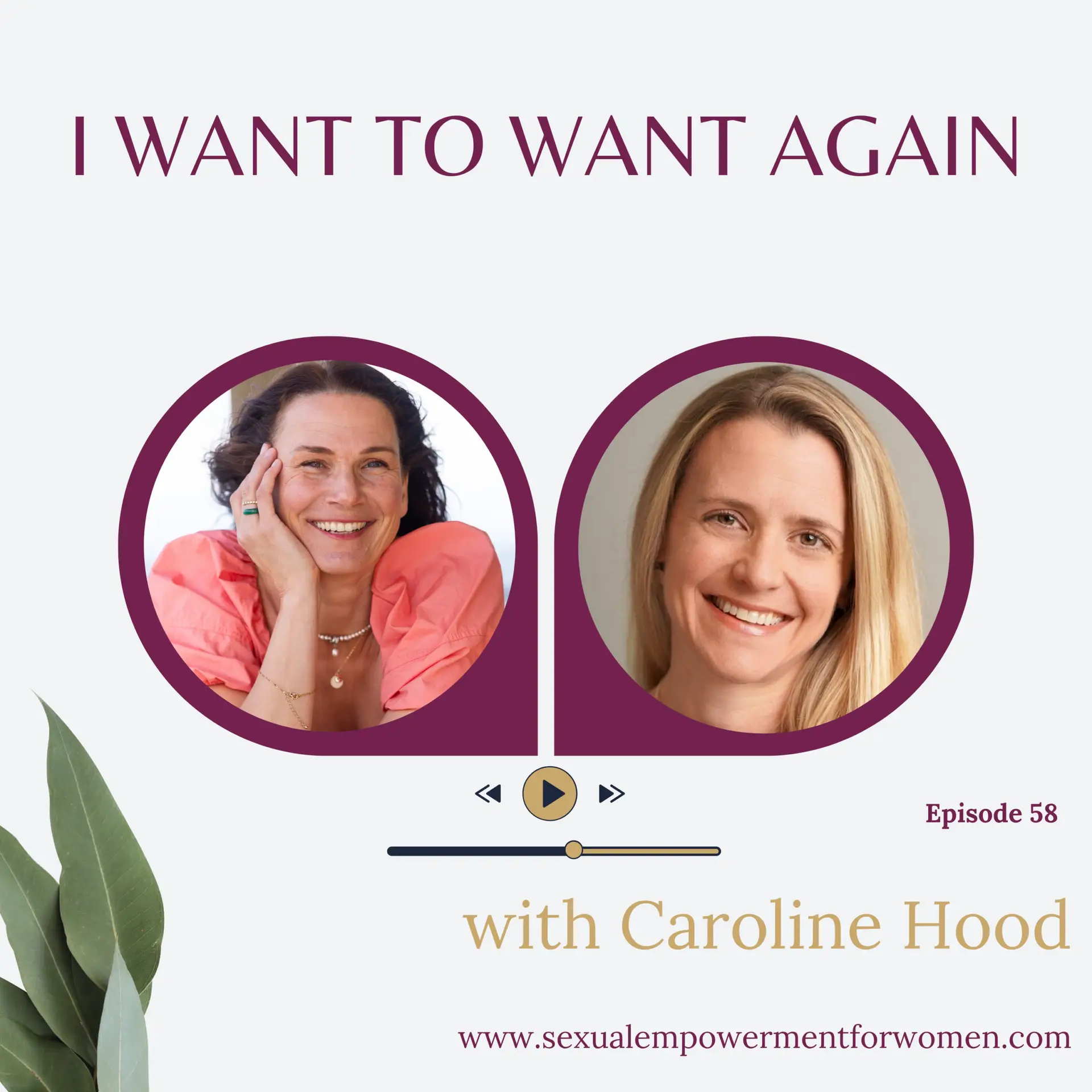
You love him. You just cannot find your wanting. If desire has faded in your long-term relationship and you have started to wonder whether that part of you is simply over, this episode is for you. Certified sex therapist Caroline Hood explains why low libido is almost never the real diagnosis, where female desire actually goes after years together and after children, and what to say to him when you want more and you are afraid it will land as an attack.
Watch the Episode
“I Want to Want Again”
Caroline opens the episode with the conversation most couples never manage to start. Not an accusation, not a list of everything that is missing, but something closer to longing:
We have come to this place where I do not even recognise myself anymore. I used to be this sexual person and I feel like I have lost it. I do not know where to begin. But what I know is I want to want again. I want to be longed for. I want to long for you. Could we explore this together?
That is the whole shift in a few sentences. It moves the conversation from what is broken to what you both want, and it is very hard for a partner to hear it as an attack.
Desire Does Not Disappear. It Moves.
We are told, by television, by films, by almost everyone, that desire dying in a long-term relationship is natural and inevitable. That you drift into roommate territory and the only route back to novelty is a new partner.
Caroline does not accept that. Desire is everywhere, she says. You can see it in the consumption of porn, in romance and dark romance, in affairs. People are meeting sexual needs constantly. What has happened is not that desire left, it is that it stopped living inside the agreement two people made ten or fifteen or twenty years ago.
That is a very different problem, and a far more workable one. If this feels familiar, you may also want to read Why I Don’t Want to Have Sex Again.
The Archetype of a Good Mother Is a Selfless Mother
Becoming a mother changes a woman hormonally, neurologically and socially, and we are still only scratching the surface of how profound that is. Layer the cultural message on top, that a good mother is a selfless mother, and what seeps in is that anything which gives you pleasure or satisfaction is no longer acceptable.
Caroline describes it as a zero sum error. You had six identities, sister, friend, wife, whatever your work is. You take on mother, which should make seven. Instead women delete one to make room, and the one that goes is the sexual self.
Her reframe is simple and it lands: what if I do not have to self abandon to be a good mother? You do not love your second child less because you had a first. The identities expand the same way.
Meanwhile he did not go through that physiological shift, and socially he was never asked to give anything up. So two people arrive in the same house with very different permissions, and the tension lands in the bedroom.
Why “She’s Got Low Libido” Is the Wrong Diagnosis
Couples arrive in therapy with what they call a libido mismatch. He has high desire, she has low desire, so the work must be to meet in the middle.
Caroline calls this looking at the fever and deciding the fever is the illness. Desire is downstream of hormones, communication, respect, cognitive load, curiosity, play and safety. Naming her as the low one puts the entire problem on the woman who is already carrying the children, the household and the mental load, and it leaves no room for the two of them to explore anything.
Her answer is to make it a dynamic rather than a diagnosis. He does not know what turns her on either. That makes him part of it, and it makes the work shared. This is the ground that Emotionally Focused Therapy is built on, that we heal inside relationships rather than alone.
Taught to Be Sexy, But Not Sexual
Ask why sex carries so much weight and Caroline points at the history. Religion, property law, ownership of women’s bodies, centuries of being told to be submissive. Out of all of it comes a particular instruction for women: be sexy, do not be sexual. Be looked at, do not want.
She is blunt about where that leaves us. Most of us grew up to be adults who are confused about how we are supposed to behave, so focused on the supposed to that we never asked what we want. Many women spend their whole lives pretending to be what they think they should be.
It also explains the women who use sex as leverage. It can feel powerful in the moment, but it is still built on the idea that your sexuality exists for someone else.
Where to Start if the Wanting Is Not There
Most advice jumps straight to the physical. Try masturbating, explore your body, read erotica. Caroline is all for those, and she thinks starting there misses a step.
Before the practice comes permission. She asks women to sit with four questions:
- Do I think this is important?
- Am I allowed to spend time on myself?
- Am I allowed pleasure?
- Do I think I am still valuable as a sexual being, or has that ship sailed?
A lot of women discover they do not believe they deserve it. That is the thing to work on first, because no technique survives contact with that belief.
Swap the Catastrophic What If for the Other One
Women often hesitate here because they are frightened of becoming selfish. Caroline points out the obvious: the woman who is afraid of being self absorbed almost never is. The fear itself is the evidence.
So turn the question over. Instead of what if I turn into someone who neglects everyone, try these:
- What if this brings me closer to him?
- What if this makes me feel more my own?
- What if this fills my cup, so I am more present and more regulated as a parent?
We are fluent in the catastrophising what ifs. We rarely let ourselves run the other ones.
When Sex Feels Too Heavy to Even Look At
Some women are not ambivalent, they are done. It is too heavy, too loaded, and they do not want to discuss it.
Caroline starts somewhere unexpected. Did you ever care? And then: tell me about a time when it did not feel like a burden. Underneath that flatness there are usually years of abandonment and resentment, of needs that did not matter to anyone in the house. The burden has to be put down before anything underneath it can be looked at.
And she is clear that there is a second group, women who simply are not interested and never were, with no charge on it at all. Those are two completely different situations and they need completely different paths.
Frequently Asked Questions
Is it normal to lose desire in a long-term relationship?
It is extremely common, and it is not inevitable. What usually happens is that desire stops showing up inside the relationship, not that it stops existing. Naming what changed, rather than accepting that it is over, is where couples get their traction.
What does low libido in women actually mean?
It is a description, not a cause. Hormones, cognitive load, resentment, lack of play, lack of safety and years of conditioning all feed into it. Treating the label instead of the causes is why “meet in the middle” advice fails.
How do I talk to my husband about wanting more without starting a fight?
Open with longing rather than with what is missing. Name that it feels awkward, say what you want to feel, and invite him to explore it with you. Caroline gives the exact wording in the episode, at the 26 minute mark.
Can I want sex again after years of not wanting it?
Yes. Caroline’s whole message is that this is not reserved for a lucky few. Start with permission and value rather than technique, and the rest has somewhere to stand.
About Caroline Hood
Caroline Hood is a sex and relationship writer, speaker and consultant, a licensed clinical social worker and certified sex therapist with more than 25 years of experience, and the author of Sex Begets Sex. She writes at desireinreallife.com, and she is on Substack and Instagram under the same name.
Ready to Want Again?
If something in this episode landed, start with the free five day challenge, Decode Your Sexual Desire. It walks you through what your desire actually needs, which is where Caroline says the work begins. Or take the free Sexual Desire Blueprint quiz to see where you are starting from.
With a big warm hug,
Tarisha