Your sexual fantasies aren’t proof that something’s wrong with you. They’re stories your mind tells to help you let go, and once you understand what sexual fantasies mean, the ones you’ve been most ashamed of often turn out to carry the most wisdom. This is for you if you’ve ever had a fantasy you’d never say out loud, or wondered how to bring more of yourself into a long-term relationship.
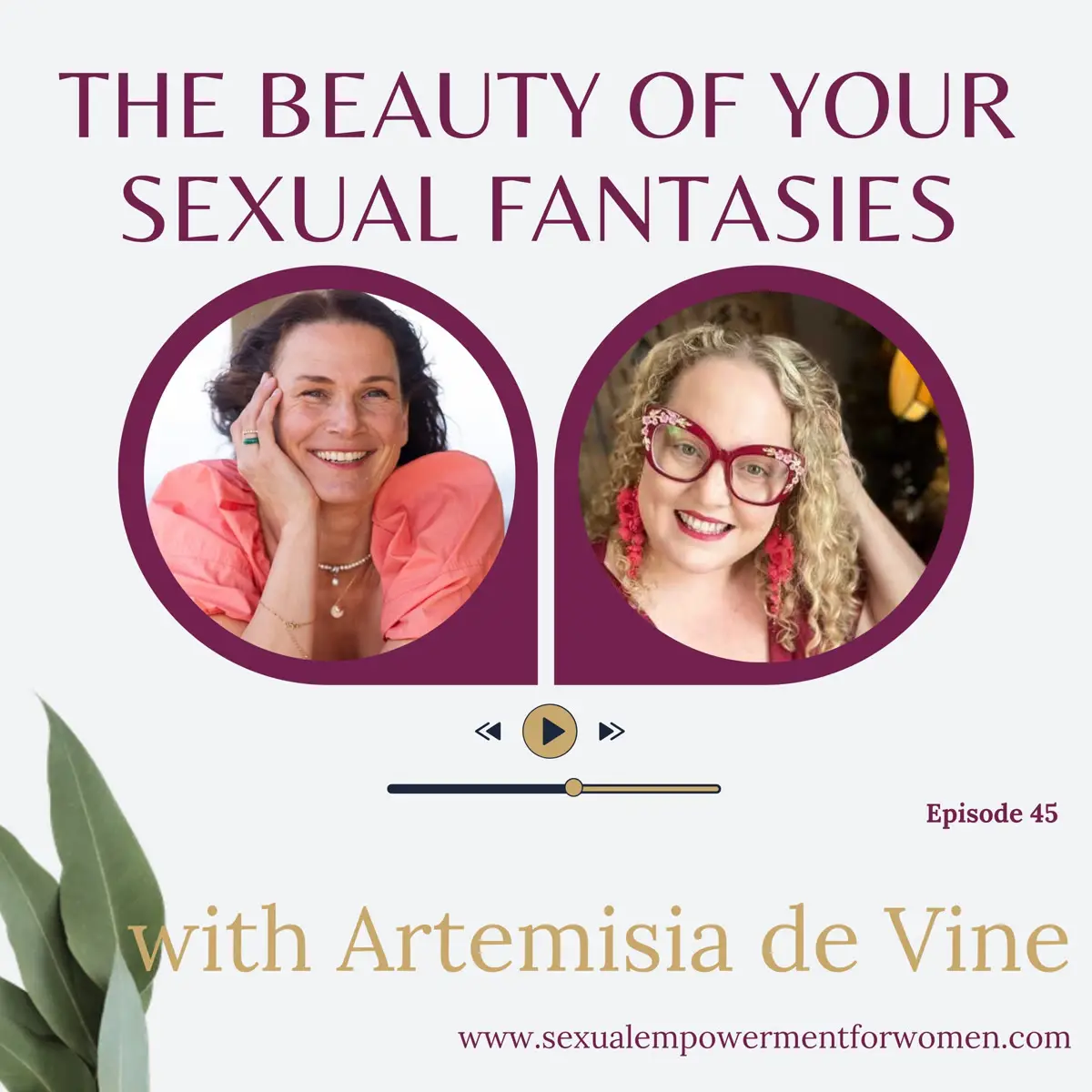
In this episode of the Sexual Empowerment for Women podcast I talk with Artemisia de Vine, and you’ll come away with a completely new way to read your own fantasies. You’ll learn the three paradoxes almost every fantasy is trying to solve, why the good girl and bad girl live side by side in so many of us, and practical ways to play with your fantasies with a partner without acting out anything you don’t want.
Prefer to listen? The audio version is right here.
Listen and Subscribe
Press play above, or listen wherever you keep your podcasts. Subscribing is the thing that helps other women find this work.
Your Fantasies Are Stories, Not Symptoms
Artemisia grew up in a very conservative home, with fantasies she couldn’t fit with her spirituality or her feminism. So she went looking for what sexual fantasies mean, and the theories she found didn’t match what she was living.
The classic text, The Erotic Mind by Jack Morin, sees fantasies through a therapy lens, where desire comes from unfinished childhood business that therapy will heal. Artemisia felt something was missing.
Her answer came from twelve years of working one-on-one with clients. Over tea she’d ask clients about their fantasies and peak experiences, and slowly she noticed a narrative underneath. What was each story changing, and what did it let the person feel?
What Sexual Fantasies Mean About How You Let Go
Here’s her theory in one line: sexual fantasies are stories that help you change states of consciousness. They take you from self-conscious, guarded and separate to open, connected and free enough to let go.
So when someone tells her a fantasy, they’ve handed her a map of how their mind works. That’s really what sexual fantasies mean: not a diagnosis, but the exact route your psyche takes to drop its guard.
She also said something I’d never heard before: sex itself is an embodied story. And like every good story, it needs obstacles.
Nobody wants to read a love story where they met, fell in love and everything stayed nice. We want to see how they get through it.
I found this so freeing. Artemisia believes that even with a perfect childhood and a society with no sexual shame, we’d still fantasise about domination, submission, multiple partners and all the rest. These aren’t wounds, they’re just part of being human.
Paradox One: Feeling Safe Versus Letting Go
Artemisia describes three paradoxes that fantasies help us move through. A paradox isn’t right versus wrong, it’s two right things pulling against each other.
The first is your ego versus your desire. Your ego keeps you safe and separate, and it’s healthy, because without it you couldn’t hold a boundary. Desire, on the other hand, wants to merge and take the risk.
Ask anyone about the best sex of their life and they’ll usually say they lost themselves. That’s desire winning. And according to Artemisia, the friction between staying safe and letting go is what actually creates arousal.
Paradox Two: Your Pleasure Versus Theirs
The second paradox is self versus lover. Your path to letting go is as unique as a fingerprint, and it’s always at least a little different from your partner’s. Yet we badly want them to be turned on by what turns us on, so we can feel safe enough to relax.
You’ll know this one if you’ve ever received oral sex and wondered whether they’re only doing it out of obligation. That tension, the do they really want me? wave, is a big source of arousal too.
This is where long-term relationships often go flat. Honeymoon hormones do the work at the start, but once they wear off, if you don’t understand your erotic narrative and how it differs from your partner’s, you’ve got no way to create that friction on purpose.
Paradox Three: The Good Girl and the Bad Girl
The third paradox is self versus community. With her anthropology background, Artemisia says she hasn’t heard of a culture without a story teaching that a good person sacrifices herself for the greater good.
Women carry this one hard. So many of us have given ourselves away for so long that we honestly don’t know what we want anymore. And when the good girl is the selfless one who never takes for her own desire, wanting anything for yourself starts to feel like being the bad girl.
According to Artemisia, the goal of every sexual fantasy is to give you psychological permission to follow your own desire. The fantasy builds in the very thing you fear, which she calls the poison, and then adds the antidote.
Take dirty talk where you’re called a name like “slut”. You get labelled the worst thing a woman could be for following your desire, and yet in the story you aren’t rejected at all. Instead, you feel wanted and accepted.
The same logic sits behind non-consent fantasies, and Artemisia was very clear that nobody wants their consent violated in real life. A non-consent fantasy is a symbolic story, not something to act out literally.
In the fantasy, being “made” to do it lets her have the sex she really wants and still stay the good girl, because it’s not her fault. It’s like saying they made me eat the whole chocolate cake.
But the antidote has to be there, or the fantasy just feels horrible. When it works, she’s the one who instigated it and created the safe container, everyone is focused on meeting her needs, and underneath it all she’s actually the powerful one.
Bringing Your Fantasies Into a Long-Term Relationship
I asked how a woman in a monogamous relationship could actually play with this. The good news is you don’t have to act out a threesome or anything literal. You play with the narrative inside the fantasy instead.
- Share a secret. Make something you both enjoy feel taboo, as if the community would be outraged. It’s our little secret, isn’t that naughty? That brings in the third paradox without bringing in another person.
- Use your body, not only your imagination. If submission turns you on, actually getting on your knees while you think about it brings a whole different level of response through your body.
- Build the container first. It takes the right conversations and understanding to feel safe enough. Once you know your paradoxes, very simple things can activate the whole story.
If talking about this feels daunting, these erotic communication skills are a good place to begin, and you might enjoy creating erotic rituals for long-term couples too.
Telling someone a fantasy can feel threatening at first, so Artemisia suggests starting small. Her free celeb swoon technique has you look at several photos of the same attractive person and notice why some draw you in more. That difference points to the story running in the back of your mind.
Start by Making Friends With Desire
For any woman hearing this for the first time, Artemisia says the very first step is forming a new relationship with desire itself. We’ve learned not to trust it, because wanting means you might not get, and that hurts.
Desire also doesn’t seem to understand consent, it just reaches for what it wants. So you need practical tools for a two-way relationship with it, where you can trust its wisdom and still protect yourself and your partner.
These are learned skills, so there’s no shame in getting help with them. If you’ve felt shut down in a sexless marriage, this conversation might open a door you didn’t know was there.
Frequently Asked Questions
Is it normal to fantasise about things I’d never want in real life?
Yes. Artemisia sees fantasies as symbolic stories that help you let go, not as secret wishes you want to act out.
What does a non-consent fantasy mean?
It’s often a way of giving yourself permission to want something without feeling responsible for wanting it. It isn’t a desire to have your consent violated.
Do I have to tell my partner my sexual fantasies?
No. Once you understand what sexual fantasies mean for you, you can bring their themes into play without describing them in detail.
Why do my sexual fantasies keep changing?
They may look wildly different week to week, yet Artemisia finds they share the same pattern across your whole life. Once you see it, you’ve got the keys to endless date nights.
About Artemisia de Vine
Artemisia de Vine is a sexual fantasy expert, certified somatic sexologist and former professional dominatrix with a BA in anthropology. She’s the author of the upcoming book The Spirituality of Smut: The Surprising Wisdom of Sexual Fantasies and creator of the deVinery Method, which teaches the desire compass, how to decode your own erotic narrative, and the journey of play. Get her free celeb swoon technique at MyFantasyIs.com and find out more about working with her at artemisiadevine.com.
Ready to Understand Your Own Desire?
Take the free 60 second quiz and discover your Sexual Desire Blueprint: sexualempowermentforwomen.com/quiz. Or start the free mini-course, Reclaim Your Sexual Confidence.